


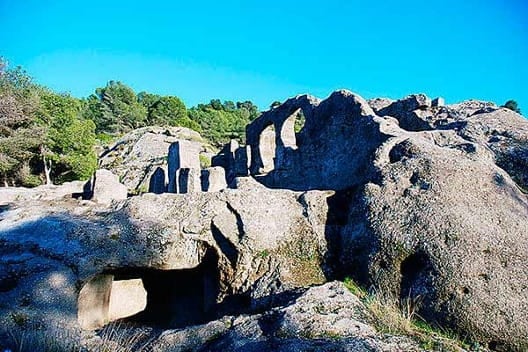
What is Bobastro and what was it built for?
Bobastro is the most important 9th-century rock-cut complex in Málaga. A few metres from what was once the fortress lie the remains of a Mozarabic rock-cut church, destroyed by Abd al-Rahman III following the definitive capture of the enclave and the defeat of Omar ibn Hafsún’s successors. The existence of a Christian church can be explained by ibn Hafsún’s conversion to Christianity, which contributed to his defeat, as he lost the support of many of his followers.
During the Islamic rule of the Iberian Peninsula, the Mozarabs (Christians living in Muslim-controlled areas) were forbidden from building new churches. Cave churches were a way of circumventing this ban. Rafael Puertas Tricas, former director of the Museum of Fine Arts and Archaeology, has spent decades conducting research and excavating the area around the church, leading him to conclude that there was even an adjoining monastery.
Stay in La Garganta and visit the Bobastro Ruins, the Caminito del Rey and the Álora Museum
History of the Bobastro Ruins
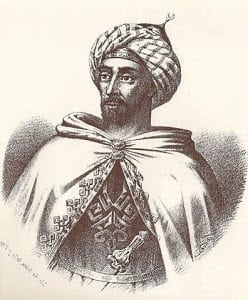
Omar ibn Hafsún is the focus of a cultural tourism route. Omar ibn Hafsún led the most significant revolt faced by the Emirate of Córdoba in the late 9th and early 10th centuries. It was the last attempt by the aristocracy of Visigothic origin to retain their feudal privileges. Parauta is almost certainly Omar’s birthplace; he was a descendant of a Visigothic family who had converted to Islam (the Muladis). The importance his family held in the area is evidenced by the fact that a brother of his father was able, on two occasions, to provide him with a group of forty armed men.
A brawl that ended in death forced Omar to flee to Tahert, in what is now Algeria, where he worked as a tailor’s apprentice. Legend has it that an elderly man from Al-Andalus visited his workshop, prostrated himself at his feet and prophesied that he would rule a great kingdom. On his return to his homeland in 880, he rallied to his cause those who were dissatisfied with the taxes that Córdoba imposed on the Muladis. He gathered a band of followers with whom he fortified himself in Bobastro, a veritable stronghold from which he kept the Córdoba authorities at bay. At first, the Umayyads saw him as a mere bandit, but they soon realised that he was destined for greater things.
Things were going so well for him that the Emir of Córdoba, Muhammad I, sent a strong contingent, and Omar surrendered, agreeing to enter the Emir’s service along with his men (in the year 883); as part of the Umayyad army, he took part in a campaign through the lands of Álava. But barely two years later, he returned to his life as a rebel and to Bobastro, where he rallied hundreds of Mozarabic, Muladi and even Berber supporters, united against the Cordoban aristocracy of Arab origin. Hafsún went so far as to create an alternative state to the Caliphate – an embryonic state that sought to legitimise its power and gain external recognition. At its height, it came to dominate the territories of the present-day provinces of Cádiz, Seville, Córdoba, Jaén, Granada, Almería, Murcia and, in particular, Málaga, where it had its headquarters in Bobastro (Ardales), with the ups and downs caused by the constant struggle against the Cordoban authorities.
When Omar ibn Hafsún converted to Christianity, around the year 898, he won the support of the predominantly Christian population of the Málaga mountains, but a significant section of his followers turned their backs on him.
In 891, Omar ibn Hafsún marched on Córdoba and was defeated by Abd Allah at the decisive Battle of Poley (Aguilar de la Frontera). This marked the beginning of his decline. Even so, he managed to maintain his power for a few more years, but lost control of some of the strongholds he had held either directly or through alliances.
In 912, Abd al-Rahman III arrived in the emirate and resolved to pacify al-Andalus. Following the conquest of Écija, Baza and Salobreña, he attacked Bobastro on an expedition during which he succeeded in capturing more than 70 strongholds. The attacks continued until 917, when Omar ibn Hafsún died in the fortress of Bobastro. His sons kept the flame of the uprising alive until 928, when his son Suleyman was finally defeated at Bobastro by Abd al-Rahman III. Omar ibn Hafsún’s body was exhumed. Finding him buried in the Christian manner further enraged Abd al-Rahman III, who ordered his remains to be hung from the walls of Córdoba, where they remained for years as a warning to the rebels. The Hafsún clan was forced into exile. Omar ibn Hafsún’s daughter, Saint Argentea, is remembered in the Catholic Church as a virgin and martyr.
How to get to the Bobastro Ruins
The ruins of Bobastro can be reached via the Álora–Ardales road, about 2 km north of El Chorro and on the southern side of the Gaitanes Gorge. A word of advice: if you’re travelling in this area, don’t miss the fantastic Caminito del Rey, which offers stunning views and an unforgettable experience. We tell you all about it on this page.
What is there to see around Bobastro?
Situated between the regions of Guadalhorce and Guadalteba, El Chorro is a spectacular mountainous enclave in the heart of the Desfiladero de los Gaitanes Natural Park, an area protected by the Regional Government of Andalusia since 1989 due to its great ecological value and its extraordinary scenic, historical and palaeontological riches.