


We’ll tell you all about the Caminito del Rey
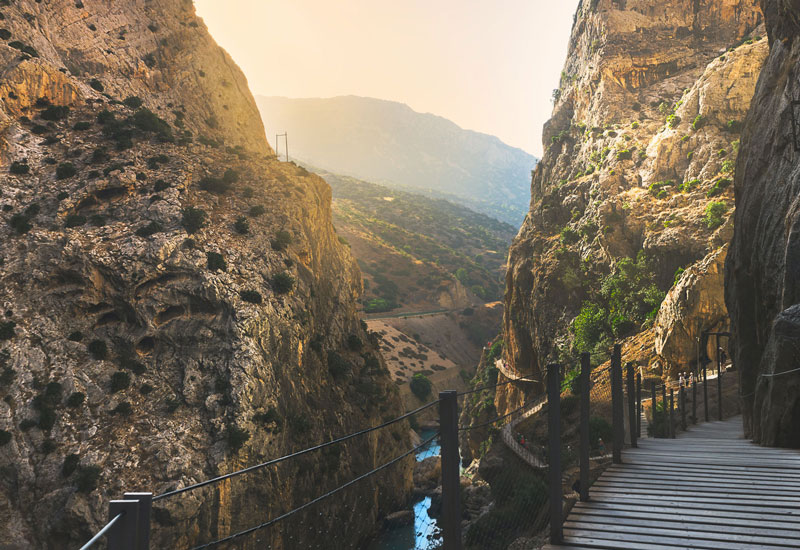
The Caminito del Rey in El Chorro, a footbridge suspended above the gorges of the Sierra Huma, clinging to the vertical cliffs of the Desfiladero de los Gaitanes – a path that seems to have sprung from a dream rather than from the prosaic need to link two hydroelectric power stations via the shortest route. The Caminito del Rey is such a unique feat of engineering that its construction involved fishermen – accustomed to hanging from the rigging of their small sailing boats – who became labourers working inland.
If you’d like to find out more about our natural landscape, we recommend taking a guided tour of the Caminito del Rey.
How to get to El Caminito del Rey
You can get to El Chorro by train, getting off at the El Chorro – El Caminito del Rey stop; or, if you prefer to come by car, you can park in the South Zone, take the shuttle bus to the North Entrance and walk along the Caminito del Rey heading south.
As the walk is linear rather than circular, visitors used to have to make their own way back to the starting point once they had finished the walk. This shuttle bus service was introduced to improve the visitor experience.
The shuttle bus stops right outside our door, and its timetable is from 9.00 am to 6.00 pm in winter and from 9.00 am to 8.00 pm in summer. So, when you leave the Caminito del Rey, we’ll be waiting for you so you can enjoy the finest traditional cuisine at our restaurant in El Chorro or relax in one of our rooms.
Interest information
Frequently asked questions from visitors before walking the Caminito
We make it easy for you – at La Garganta we offer various booking options:
You can book the Caminito del Rey with one of our local guides, who will explain the history, the landscape and more. Check ticket availability.
We also offer the option of combining the Caminito del Rey with other activities. Our Active Tourism team puts together activity packages to make your visit to El Chorro truly unique.
And although there are other ways to book, you’ll need to do so well in advance as tickets tend to sell out quickly, especially at weekends. If you can’t find any tickets, at CTR La Garganta we can get them for you straight away.
You can check the ticket price when you make your booking; it will vary depending on the type of ticket.
The quickest way to find out how much tickets for the Caminito del Rey cost is to check our Tickets page. For example, a ticket including a guided tour and shuttle bus costs around €31.
You won’t be able to book same-day tickets via the booking website. If you have any queries, please let us know via our contact form and we’ll be happy to help.
Guided tours are designed to give you an in-depth understanding of the Caminito, covering every detail: its history, construction, restoration, biodiversity and interesting facts… They cost a little more and are limited to a maximum group size of 25 people. A specialist tour guide will explain everything you need to know about this fascinating route.
If you’d rather do without and explore at your own pace, you can walk the Caminito without a guide without any problem. There’s plenty of information on signs along the route, or you can find out more on our website. One advantage of exploring the Caminito without a guide is the peace of mind that comes from going at your own pace, spending as much time as you like and taking a break whenever you wish. What’s more, the standard admission fee is cheaper.
The Caminito del Rey’s opening hours in winter are from 9.30 am to 3.00 pm, and in summer from 9.30 am to 5.00 pm. It is usually closed on Mondays, with the exception of certain Mondays. It is also closed on 1 January, 26 August and 24, 25 and 31 December.
The shuttle bus stops right outside our door, and its timetable is from 9.00 am to 6.00 pm in winter and from 9.00 am to 8.00 pm in summer. So, when you leave the Caminito del Rey, we’ll be waiting for you so you can enjoy the finest traditional cuisine in our restaurant opposite the Caminito or relax in one of our rooms.
On days with heavy rain, the Caminito del Rey management reserves the right to close access for safety reasons. In the event of light rain, access is permitted, although umbrellas are not allowed. As the walkway is very narrow in many sections, the wearing of a raincoat is compulsory.
Children under the age of 8 are not permitted entry. Minors must be accompanied by an adult and must present proof of their age.
Formerly known as the world’s most dangerous walkway, its recent refurbishment has made it possible for anyone to walk the Caminito del Rey in complete safety.
Anyone suffering from vertigo or heart conditions is advised not to go.
It is advisable to always wear comfortable, breathable clothing. Depending on the time of year, the time of day, the position of the sun and whether or not there is shade, there are many factors that can affect your walk; therefore, it is recommended that you wear several layers of clothing so you can adjust how warm you are. In summer, remember to wear a sun hat and apply sun cream.
The right footwear is the sort you’d wear for hiking. If you’ve got trekking or hiking boots, all the better; otherwise, a pair of comfortable trainers that fit snugly and don’t slip will do just fine. Forget about beach sandals or similar footwear.
If you’re travelling by car, you can park in the South Zone, opposite the CTR La Garganta, and take the shuttle bus to the North Entrance, then walk along the Caminito del Rey heading south.
We recommend bringing water or other drinks to keep yourself hydrated during the walk. As for food, as this is a Nature Reserve, you can bring sandwiches, chocolate bars, energy bars, nuts or fruit, but not much else. We recommend that you plan your visit so that you exit via the southern end of the Caminito, allowing you to enjoy the best traditional cuisine of the area at the La Garganta restaurant.
No one can help you prepare for your visit quite like La Garganta. We’re situated opposite the Gaitanes Gorge – known as the Garganta del Chorro – through which the recently restored Caminito del Rey runs. If you’re planning your visit, we can help you with everything from how to get there and what to do, to how to prepare and, of course, how to book your ticket for the Caminito. Click here to book your room.
Discover the history of the Caminito del Rey
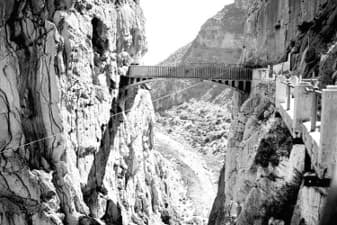
The Caminito del Rey was a suspended walkway approximately one metre wide at its narrowest points and around three kilometres long. It runs along the Desfiladero de los Gaitanes, suspended perpendicular to the gorge, anchored to the vertical rock faces, at an average height of 100 metres above the river.
Why the Caminito del Rey was built
It was built between 1901 and 1905 to link two waterfalls belonging to the Sociedad Hidroeléctrica de El Chorro company: the Salto de El Chorro and the Salto del Gaitanejo. The path began at El Chorro Station, next to the railway tracks, and allowed workers and materials to move from one waterfall to the other, facilitating the monitoring of the facilities.
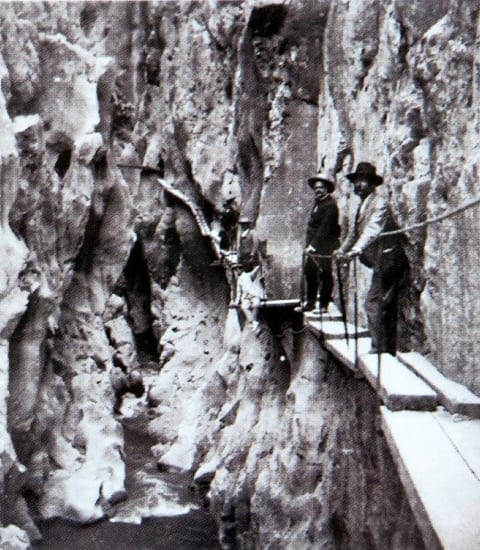
There must have been many difficulties in building the road, especially in those days. The labourers had to work suspended over the void, tied to ropes anchored to the top of the cliff. In popular imagination, such work must have been carried out by prisoners, even those sentenced to death – the only ones capable of risking their lives, so the story goes, in exchange for a reduction in the sentences they were serving.
However, the only thing we know for certain is that sailors from Málaga, skilled at hanging from the ropes of their ships, worked on this and other projects relating to the reservoir.
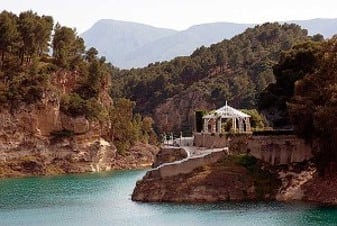
Whilst the Conde de Guadalhorce Reservoir was under construction (1914–1921), visits to the area became very frequent. Friends and relatives of the reservoir’s chief engineer, Rafael Benjumea Burín, as well as engineers and, more generally, people interested in Málaga’s industrial progress, would visit the construction site.
The views that could be seen from many points along the path were breathtakingly beautiful, so Benjumea, a great lover of nature, wanted the path to be made as comfortable as possible, given the constraints of its location. Once Rafael Benjumea had decided to improve the ‘Camino del Rey’, he had the bridge spanning the gorge – designed by civil engineer Eugenio Rivera – refurbished.
This small bridge can be seen from the road leading from Álora to the Conde del Guadalhorce Reservoir, and the view of the two rock faces joined by the so-called Balconcillo de los Gaitanes is one of the most frequently photographed in the province.
Like all places capable of captivating us, the Balconcillo also has its own legend. Any local will be able to tell the visitor about the tragic death of a young Englishwoman with flowing blonde hair, who plunged to her death from there whilst riding a white horse when life became unbearable for her. The truth is that, although everyone knows the story, no one has witnessed it nor can pinpoint when it happened.
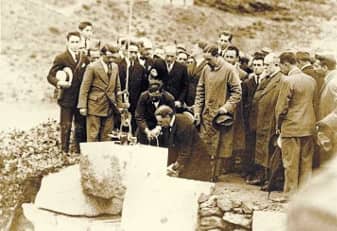
It is yet another legend to embellish a place that certainly needs no embellishment. King Alfonso XIII walked the entire length of this narrow service path on 21 May 1921, during his inaugural visit to the newly completed dam at El Chorro reservoir, which would later be named after the Count of Guadalhorce. Since then, the path has borne its current name: the Caminito del Rey.
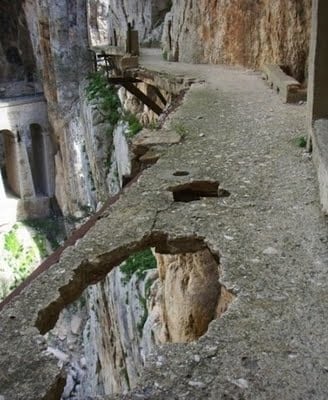
The passage of time and a lack of maintenance meant that, in recent years, the Caminito del Rey had become impassable. In several areas, the floor had disappeared, leaving only the beam that supported it. The holes in the pavement, the crumbling railings and, in general, the lack of safety along the entire route attracted many hikers who saw the danger as yet another incentive to walk the path.
Several fatal accidents in 1999 and 2000 led the Andalusian Regional Government to close off access and demolish the initial section to prevent hikers from using the Caminito del Rey.
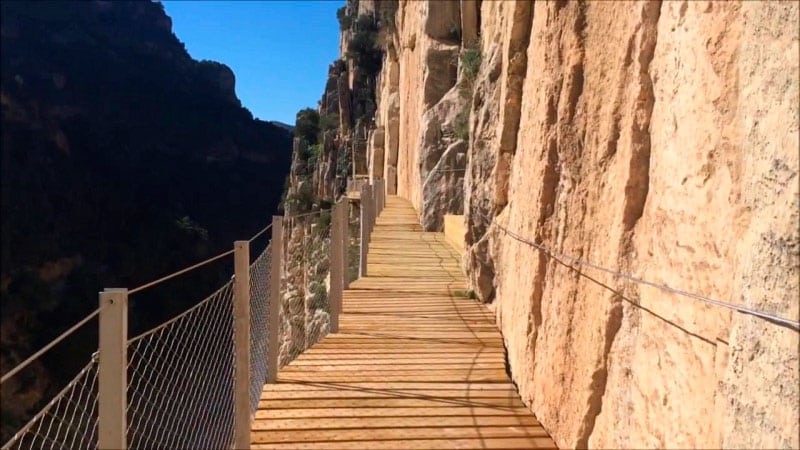
The local councils of Álora and Ardales, as well as numerous associations (residents’ groups, climbers, environmentalists, etc.), repeatedly called for the trail to be restored. In 2007, the preliminary studies and plans necessary for its complete restoration began, and it was not until 2014 that contracts relating to the restoration work began to be awarded. At the end of March 2015, we were finally able to enjoy the Caminito del Rey once again, this time fully restored and refurbished to provide a thrilling experience – and, this time, a completely safe one.
Make your visit to the Caminito del Rey an UNFORGETTABLE experience
We’ll help you get your ticket and plan your visit so you don’t have to worry about a thing – just enjoy yourself to the full.
Explore the Caminito del Rey with Google Street View
Puedes recorrerlo con nosotros pulsando las indicaciones que aparecen ‘a tus pies’, para dar pasitos cortos, o más adelante para dar saltos más largos. Merece la pena detenerse durante el recorrido y contemplar la belleza del entorno.